Analytics / Case study
FDA Drug Shortages Analytics
A Power BI dashboard exploring US drug-shortage listings by therapeutic category, manufacturer and duration.
- Power BI
- Power Query
- DAX
- Data Visualisation
Key result
The implemented dashboard provides category, manufacturer, availability and posting-year comparisons, alongside distinct listing and drug counts. The genuine repository screenshot is retained with its October 2026 snapshot context.
Limitations at a glance
The repository notes that resolved shortages are removed by FDA after approximately six months, preventing reliable measurement of complete resolution times from this snapshot.
Read all limitations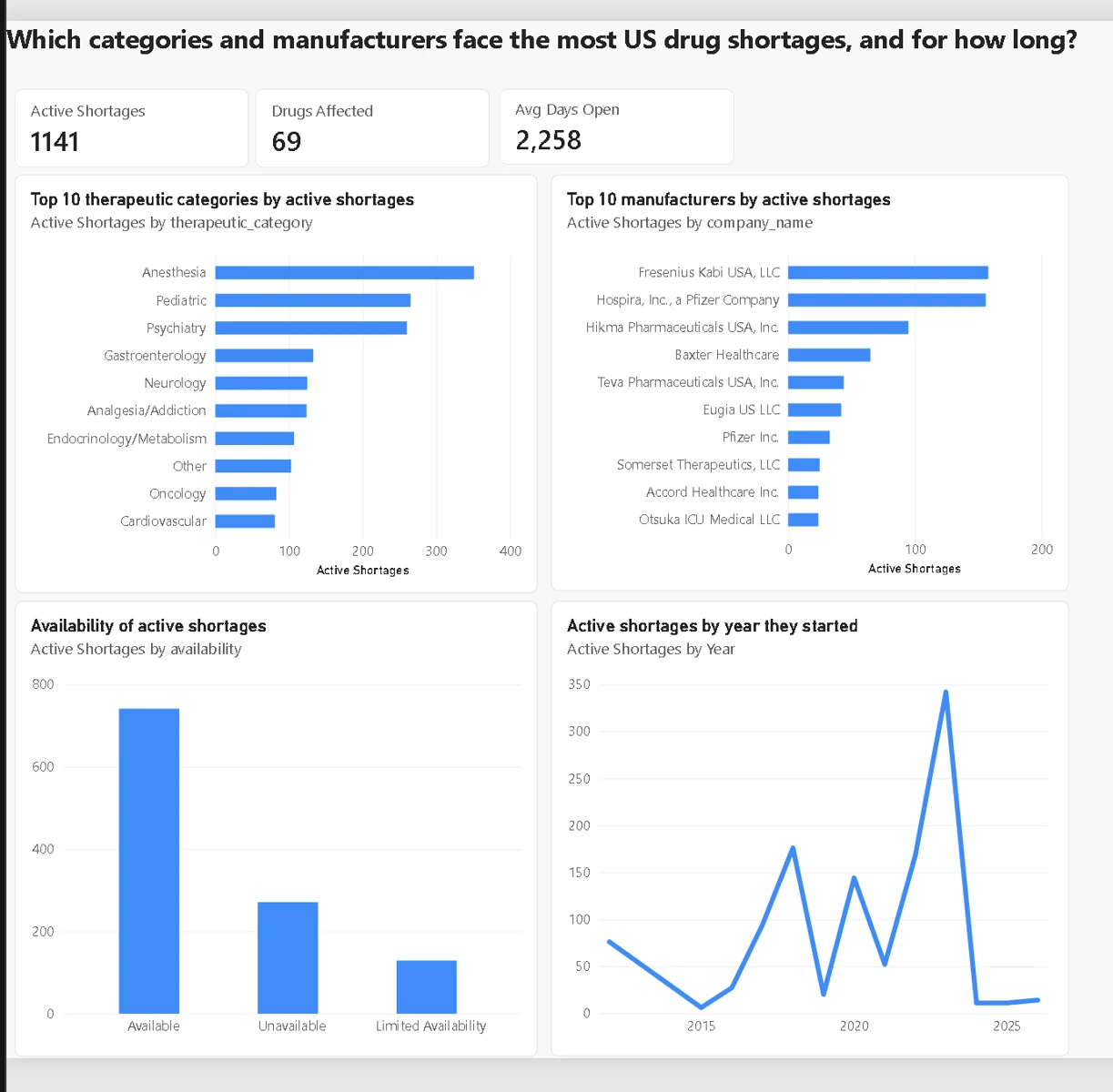
Problem
Which therapeutic categories and manufacturers have the most FDA-listed US drug shortages, and how long have current listings been open? This descriptive dashboard organises a public snapshot into a readable analytical view.
Data or modelled system
The repository describes an October 2026 openFDA Drug Shortages snapshot: 1,582 source records flattened into 2,386 rows, one per therapeutic category. The underlying FDA/openFDA data is public domain.
Category expansion means row totals are not distinct shortage listings. A listing is also not the same thing as a distinct drug.
Implementation
Power Query handles loading and types. Preparation converts dates to ISO format, corrects availability typos and labels missing values as “Not reported”. The Power BI Project format keeps the report and semantic model in versionable text files.
Approach / workflow
Use separate DAX measures: distinct shortage_id values filtered to Current for active listings; distinct generic_name values for affected drugs; and an average of days since initial posting across current shortage IDs.
Top N views compare categories and manufacturers, while availability and posting-year views provide context. The README describes a DataFolder parameter, but the shipped Power Query source uses an author-machine path; users must edit that source path to load the included CSV.
Evaluation
This is descriptive analytics, not predictive modelling. Interpretation depends on correct counting definitions, filtering and snapshot context; no independently reproduced audit or forecast performance is claimed.
The days-open measure uses DATEDIFF with TODAY(), so it changes with report refresh date even when the CSV snapshot is unchanged. It measures the age of currently listed shortages, not their final resolved duration.
Results
The implemented dashboard provides category, manufacturer, availability and posting-year comparisons, alongside distinct listing and drug counts. The genuine repository screenshot is retained with its October 2026 snapshot context.
Numerical screenshot values are author-reported snapshot outputs, not live totals. No numerical finding is presented here as a current real-time statistic.
Limitations
The repository notes that resolved shortages are removed by FDA after approximately six months, preventing reliable measurement of complete resolution times from this snapshot.
A drug may appear in multiple categories, and multiple listings may relate to the same generic drug. Category totals must not be summed as distinct drugs or listings. The report is not a real-time shortage monitor.
Repository and reproducibility
The public repository includes a CSV snapshot, Power BI report and model definitions, DAX measures and setup instructions. Open the PBIP in Power BI Desktop on Windows and edit the Shortages Power Query source path to your local included CSV; the README’s DataFolder parameter is not implemented in the shipped source.
A date table, star-schema model and drill-through detail page are documented next steps, not completed features. Source: open.fda.gov/apis/drug/drugshortages/.